There was no-one better with their words than my dad. The way he expressed, well everything – the good, the bad, the ugly – had me enthralled. He could turn an ordinary moment into a story, a warning into a performance, and a throwaway comment into something unforgettable.
He had that rare gift of making words feel alive. They didn’t just leave his mouth and disappear into the air – they landed, they lingered, they made themselves at home inside you.
Then there were the quirky, outrageous things he would say – the kind of lines that shocked you, made you laugh, and at times really upset me, but over time made perfect sense all at once.
For example, the time he told my boyfriend, well technically ex-boyfriend at the time, that came back knocking on my door, after sleeping with another girl. Dad didn’t miss a beat. He marched up to within an inch of his face and said, ‘IF YOU HURT MY DAUGHTER AGAIN, I’LL GET A SHOTGUN, STICK IT UP YOUR BACKSIDE, AND BLOW YOU FROM HERE TO KINGDOM COME.’ It was dramatic, ridiculous, fiercely protective and so undeniably him.
Over the years, somewhere, somehow, I became a lover of idioms. I think that love began with him. I loved the meaning of different words, which were just individual words, put together to make some sort of sense. Words for me could be playful and clever, they could paint a picture while saying something deeper underneath.
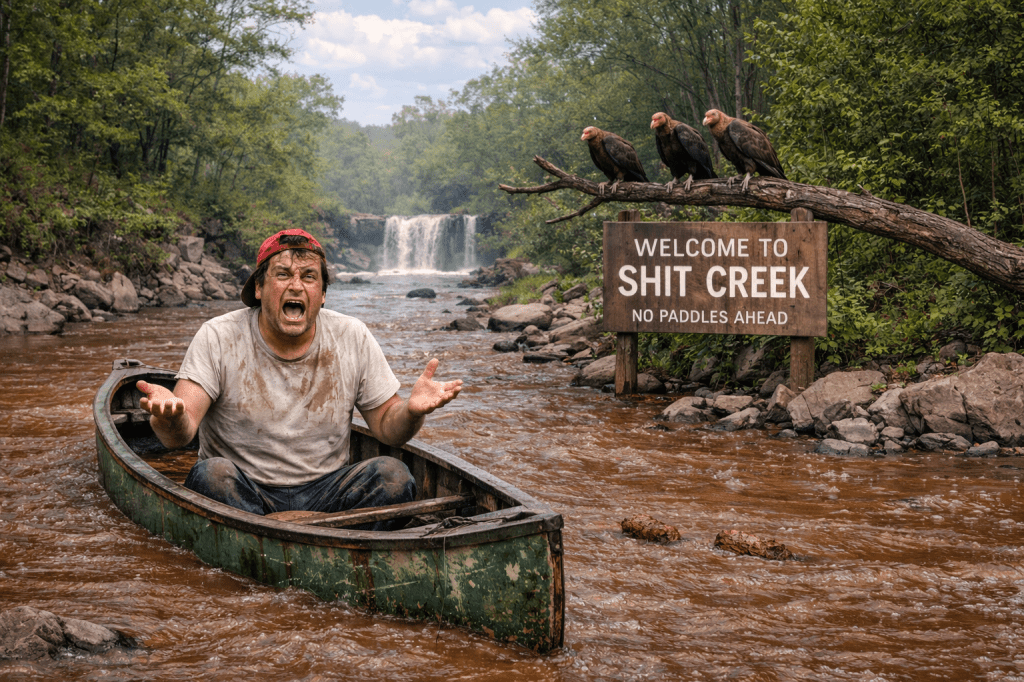
I remember Dad saying, ‘Well he’s up shit creek without a paddle.’ What’s going on? Was the creek actually full of shit? If it was, whose shit? What happened to the paddle? Where’s the boat, that was meant to have the paddle?’ Was there even a boat, or someone stranded in the middle of this dark, filthy creek? I found this kind of language hilarious, confusing and endlessly interesting.
Time and age eventually gave me understanding. Oh yeah, you’re in a difficult situation, with no easy way of getting out of it. It meant you were properly stuck – stranded in the middle of a mess, with no control over where you were headed and no easy way of getting yourself out. It sounded funny, but it carried a sense of helplessness, of consequences already in motion, of being forced to sit in the discomfort of something that had gone wrong.
Maybe that’s why it stayed with me. It wasn’t a neat or polite expression, but it was honest, and Dad was nothing but honest. Somehow, in Dad’s way of saying it, even something bleak sounded vivid, funny and strangely wise.
That was the beauty of Dad’s expressions, they made language feel bigger than itself. It invited me to imagine, to question, to laugh before I even understood.
Made perfect sense….to me. It was the magic of Dad’s words and I loved words. I think I loved them because he did first.
 writerunblockedrepublic
Leave a comment